Linton- Life in the Collections


William James Linton:
38) The Jubilee of Trade. A Vision of the Nineteenth Century after Christ.
London 1843 / 1850
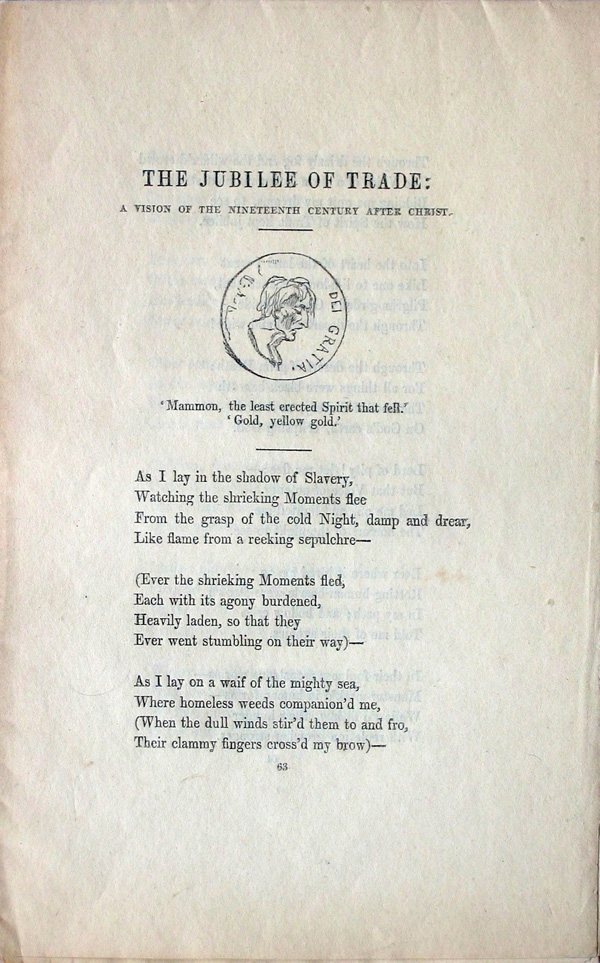
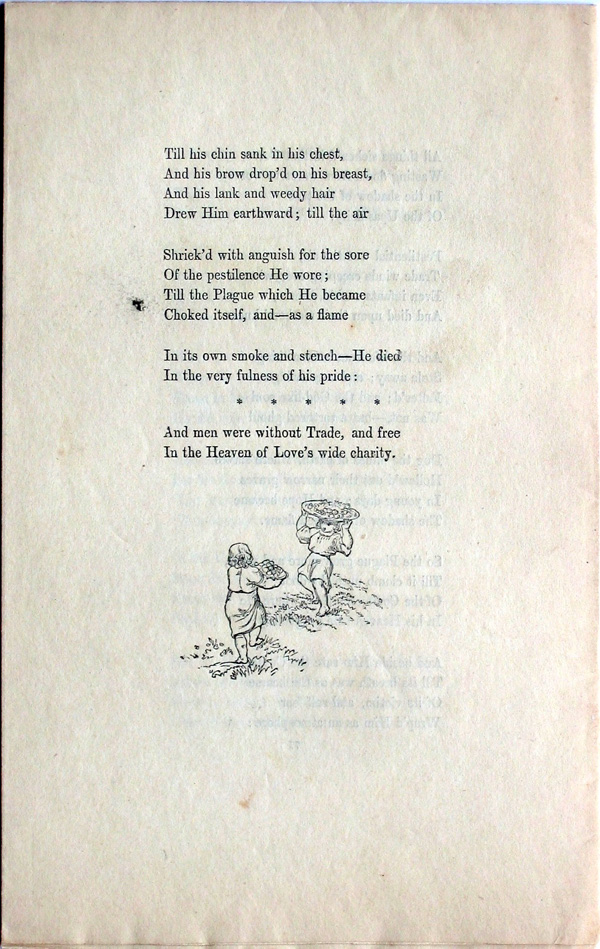
Linton dated the formulation of the poem to 1843, but it was not published before 1850. There are two different versions in the collection: A single, undated pamphlet with uncut pages that run from pp. 63â?? 78. The two illustrations are taken from the â??Bob-Thinâ? poem and were probably engraved in 1845. The initial vignette, an image of a coin symbolizing â??Mammon, the least erected spirit, that fellâ?, was also used on the cover of the â??Bob Thinâ?edition of 1845, and on p. 15. The tailpiece of the poem â??The Jubileeâ? is taken from an image in â??Bob Thinâ? (p. 23). It was a habit of the late Linton to re-shuffle his works in such an economic way. The second version of the poem is included in a compilation, which is definitely a product of his late Appledore Press and was printed by himself around 1897. It was published in a limited edition of fifty copies and exists only in unbound and untrimmed state.
In a delirium of hellish visions, the poem pictures the devastations caused by a blood-thirsty monster named the “Spirit of Trade.” Linton here presents himself as a people’s poet in the manner of Shelley. In his prophetic rage against the insanities of commerce and the tyranny of unfeeling Utilitarianism and free trade he anticipates Ezra Pound’s Usura litanies. In 1898, Burton J. Hendrick called i “a palpable imitation of Shelley’s Mask of Anarchy. He had not yet outgrown Shelley’s influence when he published, in 1848, The Dirge of the Nations, and To the Future. The tone of these poems was still didactic, but was pitched upon a somewhat higher key.”